
Building Workforce and Training Infrastructure for Rural Shelter Systems
Across rural communities, organizations are being asked to stand up increasingly complex shelter and homelessness response systems with limited staffing, limited funding, and very little operational infrastructure.
Many programs are trying to build systems of care while simultaneously responding to day-to-day crises, workforce shortages, Coordinated Entry demands, behavioral health challenges, and increasing pressure to create measurable outcomes.
One of the biggest gaps we continue to see across rural communities is not simply funding for shelter beds — it is the lack of workforce infrastructure needed to support sustainable operations.
Lessons Learned Through Del Norte Mission Possible
Over the past three years, Homeless Solutions Consultants has partnered with Del Norte Mission Possible (DNMP) in Del Norte County, California, following the County’s award of a $10 million Encampment Resolution Fund (ERF) grant through the California Department of Housing and Community Development (HCD).
Together, the work has focused on helping support the development of a coordinated shelter and homelessness response system, including a new 120-bed Navigation Center/Campus that will include:
60 congregate shelter beds
60 tiny houses
coordinated outreach and navigation
stabilization and supportive services
integrated systems coordination
The site is scheduled to open later this year, with a ribbon cutting currently planned for mid-June.
Throughout this work, one challenge consistently became clear:
Rural communities often lack the internal capacity to build standardized workforce systems capable of supporting long-term shelter operations.
The Missing Piece: Workforce Infrastructure
Many rural organizations are building programs without access to:
structured onboarding systems
operational playbooks
standardized training systems
trauma-informed operational frameworks
leadership development pathways
ongoing technical assistance support
operational knowledge preservation
As a result, many organizations repeatedly reinvent systems from scratch while struggling with turnover, inconsistent practices, burnout, and operational instability.
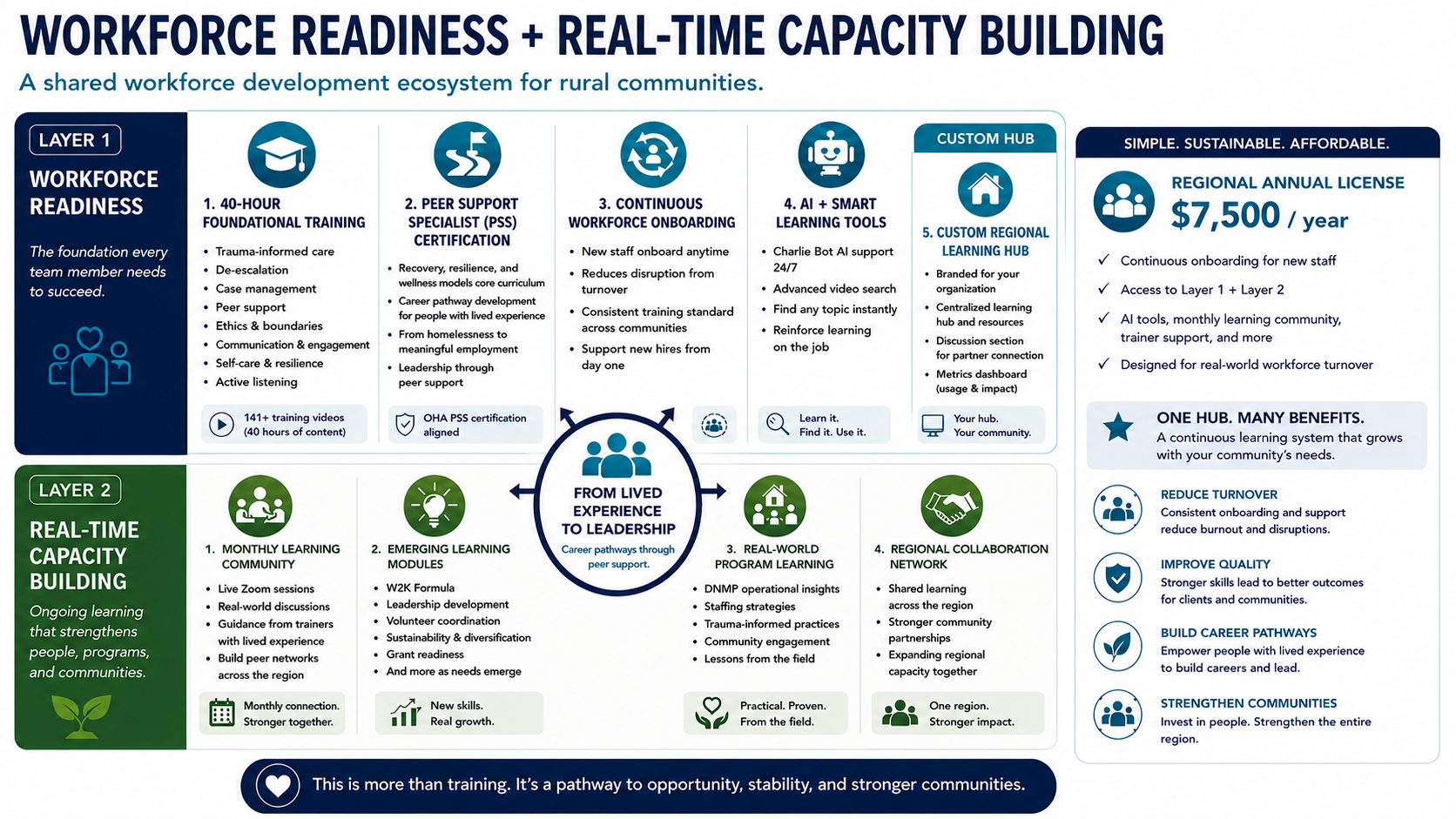
In response, Homeless Solutions Consultants began creating and recording on-demand trainings, operational guidance, onboarding systems, implementation frameworks, and organizational support tools while actively helping build and support real-world shelter operations.
Over time, this evolved into something larger: A scalable workforce infrastructure platform designed specifically for rural shelter and homelessness response systems.
A New Platform for Standardizing Training and Systems of Care
The framework is designed to help standardize trainings and systems of care across rural shelter systems that often do not have the staffing, infrastructure, or funding to build these systems internally.
The platform includes structured training and operational support around:
40 hours of Peer Support training
shelter supervision
trauma-informed operations
professional boundaries and ethics
policies and procedures
onboarding systems
operational readiness
Coordinated Entry integration
leadership development
ongoing technical assistance support
The broader vision includes:
on-demand workforce training
real-time operational support
AI-assisted knowledge retrieval
implementation guidance
regional learning communities
organizational continuity systems
technical assistance infrastructure
The AI component is not intended to replace people or leadership. Instead, it functions as a support tool capable of helping staff quickly locate:
policies
procedures
operational guidance
training materials
onboarding supports
implementation frameworks
This creates faster onboarding, more consistent operations, and better continuity across systems of care.
Why This Matters
Behavioral health systems have spent years developing trauma-informed operational models, workforce standards, and support systems.
The shelter and homelessness response industry often lacks equivalent infrastructure.
Yet shelter operators are increasingly managing:
behavioral health challenges
trauma responses
crisis intervention
housing navigation
coordinated systems
peer support environments
multidisciplinary teams
without standardized workforce tools or operational frameworks.
This work aims to help fill that gap.
Beyond Oregon
A large portion of this framework was shaped directly through the operational realities, growth, and lessons learned alongside DNMP as they rapidly expanded services and built out a more comprehensive system of care in Del Norte County.
Through this partnership, Del Norte County — via DNMP — will also become the first community outside of Oregon to begin adopting and implementing elements of the SPARC Model.
The long-term vision is the creation of a shared workforce infrastructure platform capable of supporting:
onboarding
retention
operational consistency
leadership development
technical assistance
and standardized systems of care
across rural communities.
Looking Ahead
Early discussions around statewide implementation occurred through conversations with OC3 regarding the potential for a broader rural Oregon deployment model. However, the scale and cost of supporting infrastructure across all 26 rural Oregon counties quickly demonstrated that this type of work would likely require major partnership support through organizations such as OHCS or other large funding entities.
Still, the need remains clear:
Rural communities need scalable tools capable of standardizing training, strengthening systems of care, preserving operational knowledge, and supporting the workforce responsible for keeping these systems running every day.
This work is one step toward building that future.
By Matthew Vorderstrasse