
How Did We Get Here?
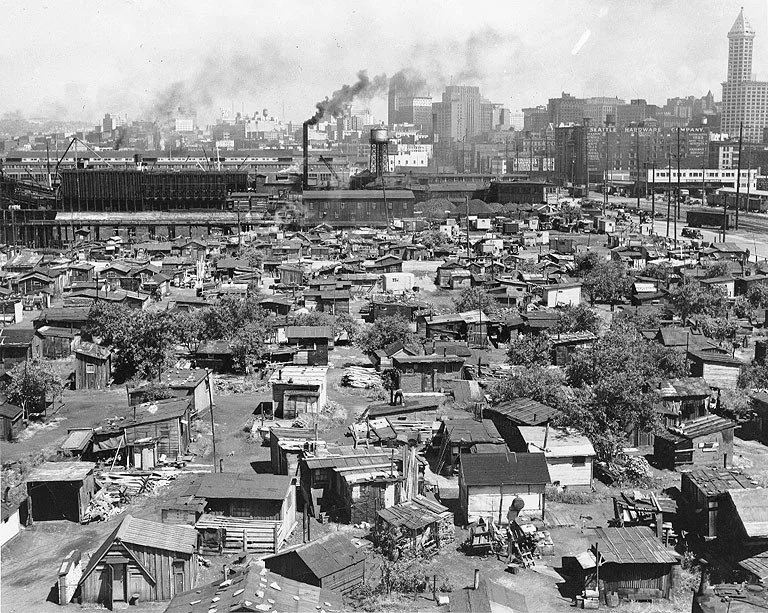
The history of housing and homelessness in the US is complex and one that has changed over time.
From 1800 to 1900 there were actually several housing crisis moments that were largely attributed the boom and bust cycles of the economy (Gold Rush for example). The most famous of these was the “Panic of 1837” that was caused by speculative and predatory lending from banks (just like 2008) and the depreciating value of domestic products like cotton.
Due to the economic decline, banks began to suspend payments and loans which triggered a 7-year recession that the US did not recover from until the Gold Rush of 1849 (boom and bust). During this recession, joblessness grew to 25%, banks closed their doors and many people became homeless.
There was little to no government intervention for the housing market during the Panic of 1837 and the other smaller recessions that took place during the 1800’s. Back then housing and homelessness improved with the economy and the economy (and war) is where the government kept their focus.
The major turning point and drastic change in government philosophy around housing came after the Stock Market crash of 1929. This event brought the US into the Great Depression. Before this moment housing was pretty much unregulated. Due to the severity of the economic downturn and the 2 million that were displaced The New Deal was to created and it ushered in a new era of economic policy and reform.
The New Deal reforms brought about many changes and created many safety nets that are still (for the most part) in place today. The most impactful came from the Housing Act of 1937. This was a landmark piece of legislation that created what we now know as HUD, and local Housing Authorities.
The goal of this act was to funnel government support to create new housing and also stimulate the economy by creating construction jobs. The New Deal did not solve everything, but it created a new framework for housing and government involvement. It created jobs and created the first generation of Public Housing in the US.
During the Great Depression we also had WWII. We all know that WWII unlocked the US’s potential for industry and helped lift the US out of the Great Depression. However, what most people do not know is that the GI Bill that was created for those returning home and it built more new family homes than any spending bill before it. The GI Bill in the 1950’s created the suburbs which caused people to leave urban population centers. This migration opened housing in the urban centers (often Public Housing) that people were vacating.
During the second half of the 1900’s we saw other economic recessions that impacted housing, but just like before, as the economy improved housing and homelessness improved with it. In 1964 we also saw the Economic Opportunity Act passed which created many Community Action Agencies that we still have today.
Where Things Turned for the Worse….
In the 1970’s we saw more economic recessions and this is where the entire system began to be turned on its head as behavioral health and housing collided with each other. Mental Health care was abysmal and most states had overcrowded state hospitals and asylums. These systems were broken and many people were horribly mistreated. As a result, there was growing political and community pressure to reform and shut down these institutions.
During this same time frame, HUD was also going through changes. Many housing projects had been impacted by extreme poverty and neglect. This led to changes that moved the creation of new housing away from HUD and into the hands of private market.
HUD, instead of taking the lead on creating Public Housing, was being changed to focus more on: regulations, funneling funding to Public Housing Authorities’ and private market, and also working with private landlords through creating the Section 8 program (now the Housing Choice Voucher program). The production of affordable housing was left to others to manage.
As both of these issues collided, we saw massive state institutions being defunded and closed and very ill people being released to the streets. Care for the mentally ill was shifted from the responsibility of the State over to the communities that they came from. However, there was never an investment into those communities to build up their own safety nets to care for these individuals as they came home.
The 1970’s and 80’s brought about the birth of modern homelessness. For the first time in US history, homelessness does not improve with the economy. The trickle-down economic theories put in place throughout the 70’s and 80’s have not worked for the majority that do not come from wealth. As a result, many communities today have a 1% or lower availability of rentals on the market and our unhoused populations are skyrocketing.
We are coming up on 50 years of doing business this way and it’s not working. A housing and homelessness paradigm shift is needed to correct our path.
Do you see other ways that we can make housing more obtainable and affordable for us and future generations?
Do you feel hopeless when you see the current state of housing and homelessness?
By,
Matthew Vorderstrasse, M.A., PHM