Why this Philosophy Matters
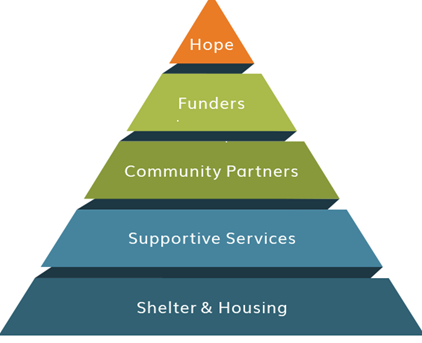
Continuum of Hope designed to show the Rogue Retreat/Medford Model of building communities of support.
The philosophy that we now teach other communities building shelter and housing continuums was not born overnight. It was put together through lived experience and trial and error. Many of these lessons pre-date my career.
What is often referred to as the Rogue Retreat Model or the Medford Model came as a result of one organization and one city being willing to say yes and take the risk to develop meaningful shelter continuums. Then through shared cooperation an entire community helped shape the model as it grew. That work inspired the graphic above.
What I want to talk about is why this philosophy matters. The above pyramid is modeled to reflect how this continuum worked to meet the need of inspiring hope to those we serve and our communities.
Each one of us can contribute something into this continuum to help build it and make it function.
Here is how the Pyramid Flows:
Shelter and Housing is the foundation of the pyramid and most communities will be composed of multiple providers working together towards the goal of serving as many as they can.
Supportive Services are often the “secret sauce” of most successful programs. This often looks Case Management, Peer Support, Community Health Workers and other support staff that act as “resource brokers” to those we are sheltering and housing.
Community Partners play a vital role in making continuums successful. From physical, mental health, addiction support, and financial literacy to everything in between. Our partners are vital in being able to help those we serve transform their lives, overcome homeless, and move forward.
Funders are pretty simple. No money. No mission. This is true on many levels. We need to be able sustain our operational costs to do this work. Without funders (donors, grants, contracts, rents, etc.) this work would be impossible.
Hope is the end goal. When you develop a continuum like the pyramid represents, you will inspire hope in those you serve and the community itself.
This entire model is meant to help build community. That is the overall benefit from creating the synergy that is required to do this work. So often those we serve have experienced extreme loss in their lives. People no longer have the same safety nets in there lives that we had just a few generations ago. Intergenerational poverty and so many other societal plaques have eroded them over the years. Housing and shelter alone cannot fix that. However, building community and the supports that come interconnectedness can.
What can you do to inspire hope and build community?
Can your agency play a part in a homeless services continuum?
Can you or your family play a part in building up a continuum?