
The SPARC Model: Building a Connected Pathway from Homelessness to Housing Stability
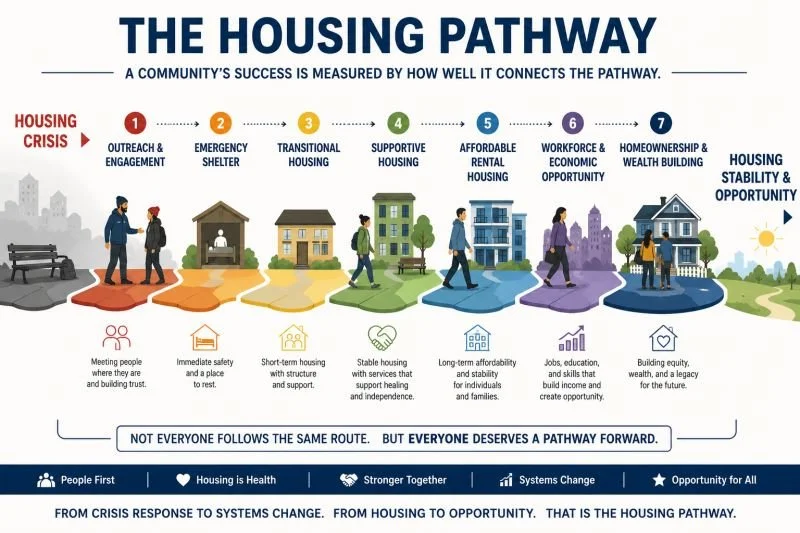
Why communities need more than individual programs to solve homelessness.
Across the country, communities are investing in emergency shelters, outreach programs, supportive housing, affordable housing development, and homelessness prevention. Each investment serves an important purpose. Yet too often, these efforts operate independently, leaving individuals and families to navigate a complicated network of services.
The challenge is not always a lack of programs. Sometimes, it is a lack of connection between them.
The SPARC Model offers a different approach.
Moving from Programs to Systems
SPARC is a community-driven framework designed to connect existing resources into a coordinated housing and homelessness response system.
Rather than creating another organization or duplicating services, SPARC focuses on helping independent providers, housing authorities, local governments, healthcare organizations, and community partners function as a connected system.
The goal is simple: Make it easier for people to move from crisis to stability, and ultimately toward greater independence and opportunity.
From Beds to Keys to Deeds
At the heart of SPARC is a connected housing continuum that recognizes that people enter the system with different needs and circumstances.
That continuum includes:
Outreach and Engagement: Connecting individuals and families with services and support.
Emergency Shelter and Transitional Housing: Providing immediate safety and opportunities to stabilize.
Permanent and Supportive Housing: Creating access to long-term housing with appropriate services.
Affordable Housing Development: Expanding the housing supply and creating sustainable pathways forward.
Homeownership and Economic Mobility: Supporting opportunities for long-term financial stability and wealth building.
These are not rigid steps that everyone must follow. People should enter wherever their needs and circumstances place them, with services and resources connected across the continuum.
Importantly, workforce development, healthcare, education, behavioral health, and other supportive services must operate alongside housing efforts rather than as disconnected programs.
Building Toward Each Other
One of SPARC's central principles is that organizations working at different points in the housing continuum should not wait for someone else to build the connections.
Shelter providers can build relationships with permanent housing operators. Housing developers can coordinate with service providers before construction is complete. Healthcare organizations can connect patients to housing navigation. Housing authorities can align rental assistance with coordinated entry and community needs.
Every partner has a role in building both forward and backward across the continuum.
When organizations intentionally strengthen those connections, the community becomes better equipped to identify gaps, coordinate investments, and help people move toward stability.
Housing Development Is Part of the Solution
A coordinated homelessness response cannot succeed without sufficient housing opportunities.
SPARC recognizes affordable housing development as essential infrastructure within the broader system.
This means connecting community needs assessments, available land, zoning, infrastructure, financing, housing authorities, nonprofit developers, and service organizations to identify where additional housing is needed and how to deliver it.
The objective is not simply to build more units. It is to build housing that responds to community needs and connects residents with the resources necessary for long-term success.
Local Leadership, Regional Coordination
SPARC is built around a straightforward understanding: communities know their needs, but no single organization can address every challenge.
Local partners maintain their independence and expertise while working through shared coordination structures, common outcomes, and stronger referral pathways.
This approach allows communities to build on existing relationships and infrastructure rather than creating another layer of bureaucracy.
It also provides opportunities to identify regional patterns, coordinate resources, and strengthen housing development strategies across jurisdictional boundaries.
A Different Measure of Success
Traditionally, organizations measure their success through individual program outcomes: shelter nights provided, people served, services delivered, or housing units developed.
Those measures remain important, but SPARC asks communities to look further.
Are people moving successfully between programs? Are referrals resulting in housing placements? Where are people getting stuck? Are available resources being used effectively? Are housing investments addressing the needs identified across the system?
Success should be measured not only by what individual organizations accomplish, but by how effectively the entire community helps people achieve stability.
Building a System That Works
The SPARC Model is being developed through collaborative work in rural communities along the Southern Oregon Coast, with broader conversations emerging about how its principles may be adapted elsewhere.
Its central message is that meaningful progress requires more than additional programs or isolated investments.
It requires intentional connections between the organizations, people, resources, and housing opportunities that already exist.
Because ending homelessness is not simply about creating more beds.
It is about building connected pathways from beds to keys to deeds, and ensuring that every part of the community is working toward that shared outcome.
The SPARC Model is a housing and homelessness systems framework developed by Matthew Vorderstrasse, M.A., PHM, emphasizing community collaboration, distributed leadership, housing development, and coordinated pathways toward long-term stability.